
 |
 |
 |
 |
 |


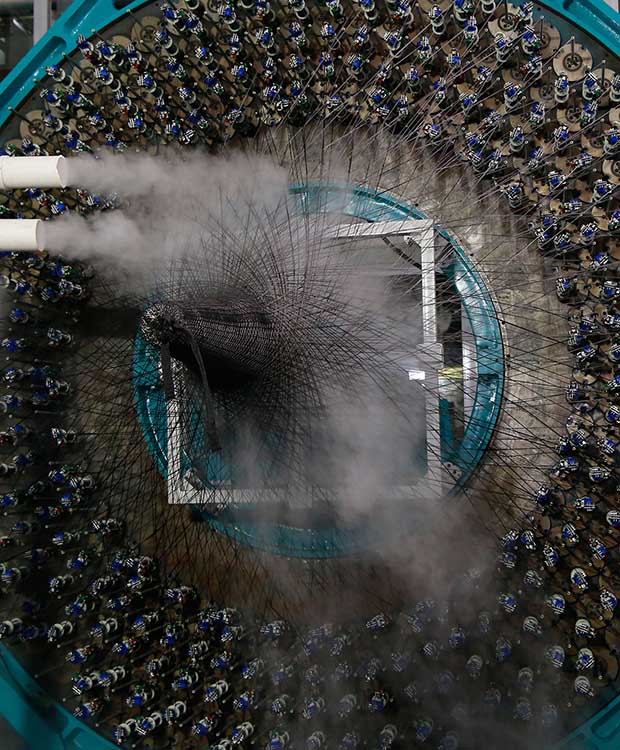
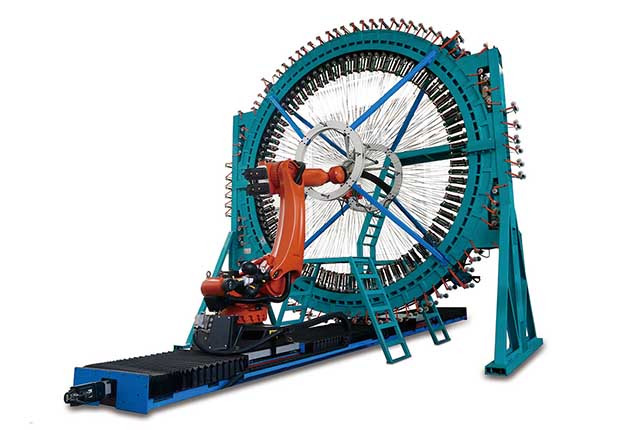
Glass and carbon fiber braiding is a high-performance manufacturing process where continuous fibers are woven into a seamless, tubular "sleeve" or complex structural shape. While the machinery is very similar to the wire braiding machines used for rubber hoses, the application and material behavior are entirely different. Instead of reinforcing a flexible rubber core, fiber braiding is typically used to create lightweight, ultra-rigid composite parts for aerospace, automotive, and sporting goods.
The process involves a large circular braiding machine (often with 48 to 144+ carriers) that weaves the fibers over a mandrel (a mold that defines the internal shape).
The Dry Braid: In many cases, the fibers are braided "dry." This creates a flexible fabric sleeve that conforms perfectly to the shape of the mandrel, even if it has varying diameters or curves (like a hockey stick or a car A-pillar).
Fiber Orientation: The angle at which the fibers are braided (the "bias angle") is precisely controlled. Changing this angle allows engineers to tune the part for torsional stiffness or longitudinal strength.
| Material | Characteristics | Common Uses |
| Carbon Fiber | Highest strength-to-weight ratio, extremely rigid, thermally stable. | Aircraft frames, bike frames, driveshafts, racing car tubs. |
| Glass Fiber (Fiberglass) | More affordable, excellent electrical insulation, high impact resistance. | Pressure vessels, boat masts, wind turbine components. |
| Aramid (Kevlar) | Incredible toughness and abrasion resistance. | Protective sleeves for high-pressure lines, ballistic containment. |
3. From Braid to Composite
A dry braid is not a finished product; it must be combined with a polymer resin (like epoxy) to become a solid composite. This is usually done via:
RTM (Resin Transfer Molding): The braided part is placed in a closed mold, and resin is injected under pressure.
Infusion: Resin is sucked through the braid using a vacuum.
Pre-preg Braiding: The fibers are coated with resin before braiding, though this is more technically challenging due to the "tackiness" of the material.
4. Advantages of Braiding over Traditional Wrapping
Compared to manually wrapping layers of carbon fiber cloth, braiding offers:
No Seams: Because it is a continuous weave, there are no "overlap" joints, which are typically the weakest points in a composite part.
Impact Resistance: The interlocking nature of the braid helps prevent "delamination" (the layers peeling apart) if the part is hit.
Complex Geometries: Braiding can easily cover "S-curves" or tapered tubes that would be nearly impossible to wrap smoothly with flat fabric.
|
|
| Wire braiding machine Wire stranding machine Wire winding machine Hose Wrap Unwrap System Fiber braiding machine Cable braiding machine |